NMMF Team Highlight: Katelin Lally

Katelin Lally has grown from being an intern studying how sea lions can learn to play video games, to a research assistant studying the secrets of dolphin echolocation clicks, to now serving as an environmental specialist analyzing acoustic effects to marine species; all over the last 4 years.
Katelin sat down with us to share all that she’s been working on, how stepping away can make you come back stronger, and how sustainability is about progress not perfection.
National Marine Mammal Foundation (NMMF): What first sparked your interest in marine mammals and marine biology? Was there a defining moment that made you choose this career path?
Katelin Lally (KL): I’ve always loved animals and the ocean. In 2012, I went on an Alaska cruise as a graduation and birthday gift, where my parents and I joined my first whale watching trip. The naturalist dropped a hydrophone into the water and explained that if the whales began bubble net feeding, we’d hear them communicating, followed by silence, and then one loud trumpeting call before they all surfaced together. To our amazement, that’s exactly what happened. Watching humpbacks bubble net feed for the first time completely hooked me, I knew I wanted to research cetaceans. That experience eventually led me to an internship at Dolphins Plus (now Dolphin Life), where I combined marine animal care with research. It was there that I truly solidified my passion for marine mammals and acoustic research.

NMMF: You’ve worked with the Foundation in a few different capacities for about 4 years now. How did you get involved with the National Marine Mammal Foundation in the first place, and what has your journey here been like?
KL: In 2022, I joined the National Marine Mammal Foundation as an Advanced Intern, working with Dr. Kelley Winship and Amber Ramos on the Enclosure Video Enrichment (EVE) project and assisting Dr. Brittany Jones and Jessica Sportelli with health classifications from (dolphin) whistles. Following my internship, I was hired as a Research Assistant with the Biological and Bioacoustics Research Team within the Conservation Biology Department. In this role, I worked with Dr. Katie Christman to study how dolphins utilize spectral cues to distinguish between different inter-highlight intervals (IHIs) in simulated echoes. This research enhanced our understanding of the dolphin biosonar system and how these animals identify complex objects by analyzing echoes from multiple reflective surfaces. Additionally, I collaborated with Dr. James Finneran on the Conditioned Auditory Response Project (CARP), which investigated the ability of dolphins to protect their hearing from loud sounds. By analyzing auditory brainstem responses, we explored ‘self-mitigation’—the process by which dolphins reduce their hearing sensitivity following a warning tone to avoid auditory fatigue and long-term damage. After leaving to pursue graduate school, I’ve returned to the Foundation and now work with the Bioacoustic Analysis and Applied Research Team (BAART), also part of the Conservation Biology Department.
For a deeper dive into some of the Biological and Bioacoustics Research Team’s work, check out some of Katelin’s co-authorships here:
The effects of inter-highlight interval and phase on echolocating bottlenose dolphins performing a two-highlight echo discrimination task
Dolphin conditioned hearing attenuation in response to repetitive tones with increasing level
Dolphin short-term auditory fatigue and self-mitigation
NMMF: What made you decide to go back to school and get your Master’s degree? And what did your thesis focus on?
KL: As I looked toward the next stage of my career, I recognized that a higher degree was necessary to unlock new opportunities and advance within my organization. This led me to pursue a Master’s degree at UC Irvine’s Master’s in Conservation and Restoration Science (MCRS) program. My team collaborated with NOAA to enhance white abalone data collection using the Underwater Information System (UWIS), a tool originally used to track diver locations. The project aimed to expand UWIS applications within NOAA’s white abalone restoration program by shifting the focus from diver tracking to monitoring white abalone spatial distribution. For more detail about the project, here is a link to my team’s website.
NMMF: Now you’re back at the Foundation, and back with the Conservation Biology Department working with the Bioacoustic Analysis and Applied Research Team, also known as BAART. Can you describe your role at NMMF and the project you currently work on?
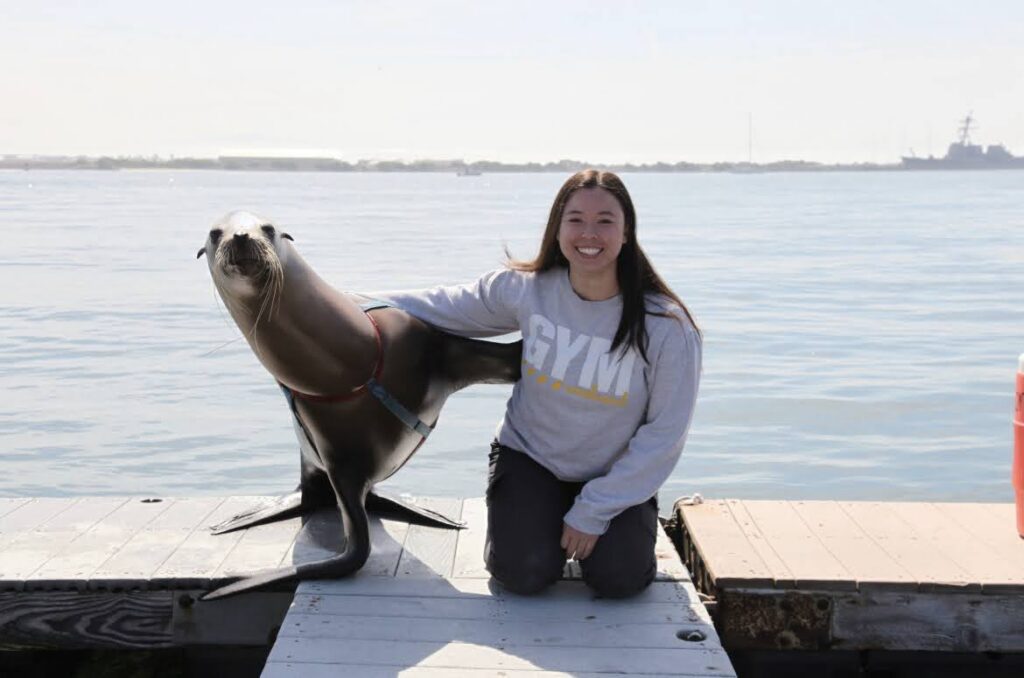
KL: In BAART, I assess the effects of sonar and explosive exposures on marine species. My role involves conducting bioacoustic and explosive impact analyses to support the Navy’s environmental compliance with the National Environmental Policy Act (NEPA), Marine Mammal Protection Act (MMPA), and the Endangered Species Act (ESA) regulations. I review and synthesize auditory, behavioral, and ecological research to develop detailed impact assessments and background reports. I also prepare materials for interagency coordination and regulatory consultations and collaborate with multidisciplinary Navy teams to refine methodologies for assessing and mitigating acoustic and explosive impacts on protected species.
NMMF: Our mission at NMMF is to improve and protect life for marine mammals, humans, and our shared oceans through science, service, and education. Can you talk about how your current work helps us achieve that mission?
KL: My work directly supports the Foundation’s mission to advance marine mammal science, conservation, and welfare. By conducting bioacoustic analyses, I help evaluate and reduce the potential effects of human activities on marine species. This research contributes to science-based management decisions, promotes environmental compliance, and informs mitigation strategies that protect marine mammals and their ecosystems.
NMMF: So you are combining the latest research with the latest policy – protecting not only marine mammals but sea turtles and fish too. That sounds like a lot to consider! What keeps you motivated when the challenges feel overwhelming?
KL: I’m motivated to keep working when I tell people what I do, and they respond not only with interest but with stories about how much more marine wildlife they see now compared to when they were younger. Hearing that reinforces my belief that the regulations and conservation measures put in place to protect marine species and the environment are making a real difference. The progress may be slow, but it’s still progress.
NMMF: When you’re not at work, is there something else you’re passionate about or currently excited about?
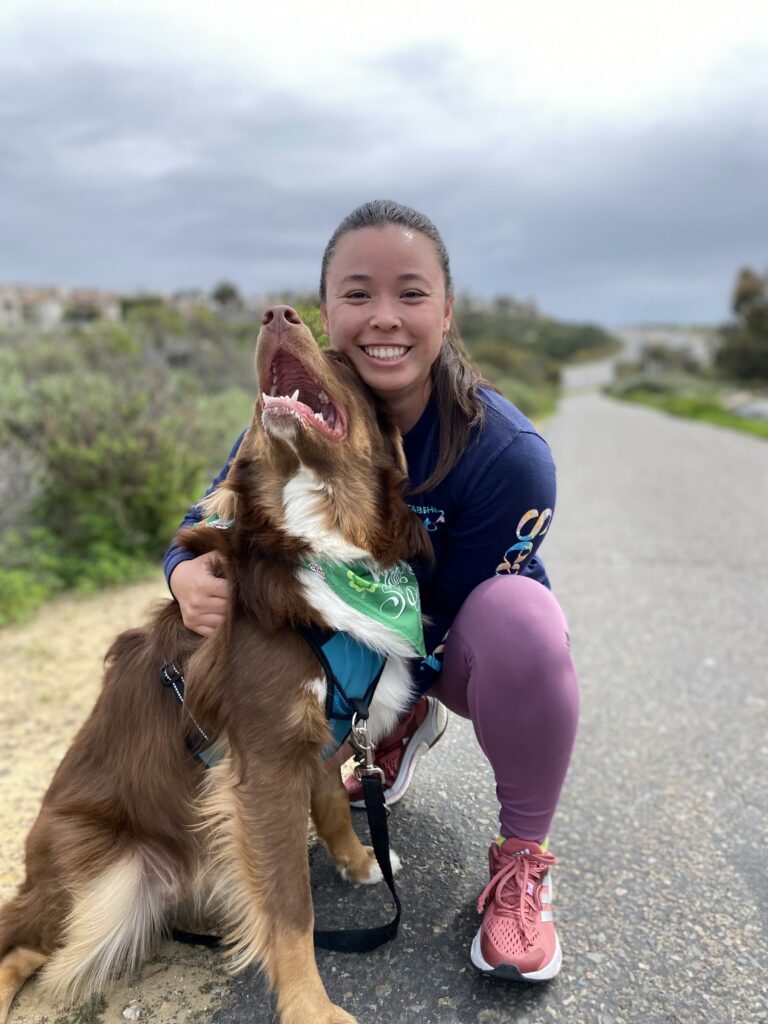
KL: I love being outdoors and trying new things with Charlie (my dog). For the past year and a half, we’ve been taking sheep herding lessons. It’s been incredibly fun (and a bit of a challenge) because he’s such a stubborn dog! Because we only herd sheep once a week, we’re still mastering the basics, but he’s come a long way since we first started. I’ve also been introducing him to paddleboarding. I thought it would be a struggle because balancing on the water can be tricky, but he has adapted quickly and is now very confident on the board. Beyond the activities I do with my dog, I really enjoy exercising; my morning workout is my essential ‘me time’ before I start my day. Lately, I’ve also started getting into crocheting, puzzles, and other arts and crafts.
NMMF: What advice would you give to students or young professionals who want to follow in your footsteps?
KL: My advice is to take on as many internships and volunteer opportunities as possible to figure out what truly interests you. Even if you find that you don’t enjoy a particular role, that experience is still valuable; it helps you rule out career paths you might have otherwise assumed you’d love. Additionally, lean on your connections (such as professors, internship advisors, and volunteer leads) to get a better sense of the industry and the positions available.
NMMF: And finally, if you could inspire readers to take one action for marine conservation, what would it be?
KL: If I could inspire people to take just one action, it would be this: do your best with everyday sustainability, but don’t let perfection be the goal. For example, don’t stress too much if you order takeout and end up with a pile of plastic containers. My favorite way to reuse them is to bring them along to gatherings where I know there will be leftovers. Similarly, since we don’t always remember to bring a reusable coffee mug, I keep one or two clean ones in my car so I’m always prepared. Swapping to eco-friendly products is a great way to become more conscious, but don’t feel guilty if you have to order them online. Sometimes the only place to find a sustainable product is a store that doesn’t align with your values; in those cases, it’s okay to make a compromise to get the product you need. Sustainability is about progress, not perfection.